Composable AI Stack – A Framework for Successful AI Deployment
A systems of the systems view that reigns in chaos and creates clarity. A systems-first framework to build scalable, modular, and secure AI stacks that actually deliver business value.

Artificial Intelligence initiatives succeed when technology, people, and processes all work in harmony. Yet many enterprises struggle to assemble an AI “tech stack” that stays relevant amid rapid innovation. To address this, we propose a Modern Composable AI Stack Framework – a systems view that integrates five pillars (Human, Outcomes, Services, Platforms, Infrastructure) with Data as a horizontal fuel and Governance & Security as a vertical backbone. This framework enables enterprise IT leaders to compose modular AI capabilities that can adapt and scale as needs change. In this overview, we’ll introduce the full stack and set the stage for a series of deep dives into each layer.
Why a Composable AI Stack?
Traditional AI solutions often take a monolithic approach – a single vendor platform or one-size-fits-all system. In contrast, a composable stack means assembling independent components into a functional whole . Each layer of the stack can evolve or be “swapped out” with minimal disruption . This modularity is crucial in the fast-moving AI landscape, where new models, tools, and best practices emerge constantly. Composable means flexibility: the ability to integrate best-of-breed solutions at each layer and reconfigure as business needs or technology capabilities change .
Notably, composability isn’t just about technology components – it extends to people and processes. A recent Techstrong.ai analysis emphasizes that a composable AI stack spans infrastructure, platform, and application layers. Our framework broadens this view to include the human and business outcome elements as equal pillars. Why? Because enterprise AI success depends not only on hardware and software, but also on human collaboration, strategic alignment, and governance across the entire AI lifecycle. In short, the composable AI stack approach provides a holistic blueprint ensuring all necessary pieces – from cloud GPUs to data pipelines to domain expertise – snap together effectively like Lego blocks.
The Five Pillars and Cross-Cutting Elements
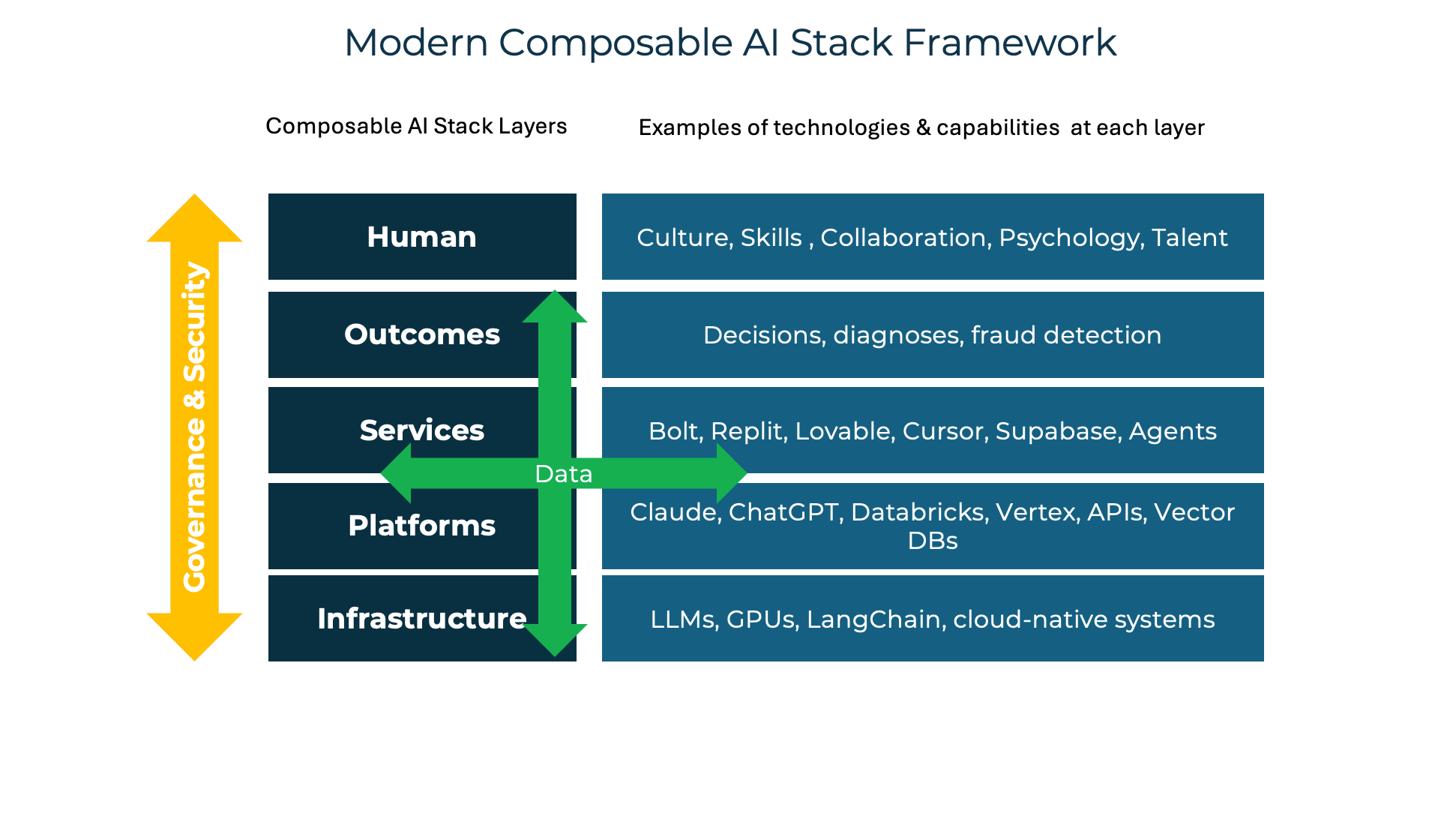
Human – The Team and Talent Layer. This top layer represents the people involved in AI (leadership, data scientists, engineers, domain experts, etc.) and their culture, skills, and collaboration. Without human intelligence guiding AI, even the best tech may falter.
Outcomes – The Business Value Layer. AI must ultimately deliver business results – whether improved decisions, streamlined processes, or new revenue. This layer focuses on aligning AI projects to key performance indicators (KPIs) and ethical standards, ensuring the technology serves business objectives and stakeholder values.
Services – The Delivery Layer. Here we have the applications, microservices, and APIs that deliver AI capabilities as modular services. This layer makes AI consumable – for example, an AI recommendation engine exposed via an API, or a set of containerized microservices that each handle a specific AI task. Composability at this layer means you can patch or upgrade one service without breaking the whole system, accelerating innovation.
Platforms – The Enablement Layer. This is the tooling and middleware for building and operating AI: data pipelines, machine learning platforms, MLOps frameworks, and (in the era of generative AI) prompt engineering tools. The platform layer connects raw infrastructure to high-level services, providing data scientists and ML engineers the means to develop, deploy, and monitor models efficiently. It bridges the gap between data science and IT operations akin to how DevOps platforms bridge developers and runtime ops.
Infrastructure – The Foundation Layer. At the base, we have the compute, storage, and network backbone: cloud instances, on-premises servers, edge devices, GPUs/TPUs, and related infrastructure. This layer supplies the raw power and environment in which AI computations run. Key considerations include scalability, latency, cost, and reliability of resources (e.g. deciding between cloud or on-prem GPU clusters, using edge computing for low-latency inferencing, etc.). As one analysis put it, AI infrastructure is the “backbone” that has evolved from traditional data centers to include cloud and edge computing
Data (Horizontal) – The Fuel that Powers All Layers. Data is often called the new oil, and in our stack it flows across every layer. From training data used by data scientists to real-time data processed by AI services, to outcome metrics fed back for improvement – data permeates the entire stack. We depict Data as a horizontal layer because data strategy, quality, and availability must be handled in a consistent, enterprise-wide manner, rather than in silos. Data engineering and governance practices need to ensure the right data gets to the right place in the right condition, feeding each layer of the AI stack.
Governance & Security (Vertical) – The Trust and Accountability Spine. Governance and security practices run vertically, underpinning every layer from Infrastructure up to Human. This includes data privacy, model governance, compliance with regulations, security of systems and APIs, and alignment with ethical standards. Just as a backbone provides structural integrity, robust governance & security provide confidence and control across the AI stack – ensuring, for example, that data is handled transparently and securely and that AI decisions are auditable and fair. We highlight this as a vertical pillar to stress that governance must be interwoven in all activities (not an afterthought). Proper AI governance frameworks help maintain accountability and trust, which in turn improves adoption and sustainable success.
How These Pieces Work Together
In practice, these layers are highly interrelated. A change in one may impact others – which is why having a systems view is so important. For instance, if you adopt a new large language model (Platform layer), you might need to adjust your Infrastructure (GPUs or memory requirements), update your Services (the API serving the model), train your Humans (upskilling engineers on prompt engineering), and reconsider Outcomes (new KPIs or new ethical implications). The composable stack model encourages thinking through such ripple effects in a structured way. It also aids in identifying gaps: e.g., do we have the right team culture (Human) and governance processes to safely deploy that cutting-edge model? If not, those need attention just as much as the tech.
Crucially, the composable approach lets you tackle each layer somewhat independently with appropriate expertise, while maintaining alignment through the overall framework. Each pillar can be owned by specific roles or teams (for example, IT architects for Infrastructure, data scientists for Platforms, business stakeholders for Outcomes), but all under a unified vision. By modularizing responsibilities in this way, organizations can be more agile. One can upgrade the Infrastructure or switch cloud providers without disrupting how data pipelines or service APIs function – as long as standards and interfaces are upheld. Similarly, if business strategy shifts, the Outcomes layer might redefine success metrics and trigger adjustments to models or services, but you won’t need to reinvent the entire pipeline from scratch.
This modular, plug-and-play flexibility is supported by industry trends. For example, enterprises increasingly adopt multicloud and hybrid-cloud strategies to avoid locking in infrastructure and to leverage best-of-breed capabilities. In our stack, the Infrastructure layer embraces that by design. Likewise, modern MLOps and data pipeline tools (Platform layer) are built to integrate with various storage or compute options, echoing the composability theme. The same is true at the Services layer with microservice architectures, which allow mixing different AI services and even third-party AI APIs. In short, the composable AI stack aligns with the API-driven, multicloud, microservices direction of enterprise IT, but extends it to also include the human and outcome dimensions often overlooked in technology-centric models.
What to Expect in This Series
Following this overview, we will publish a seven-part series, each delving into one aspect of the Composable AI Stack:
Human – Collaboration, Empathy, Critical Thinking in AI Teams: How to cultivate the right team culture and soft skills for AI success.
Infrastructure – Cloud, Edge, GPUs, and Hybrid Foundations: Choosing and managing the technical underpinnings for AI at scale.
Platforms – Data Pipelines, Prompt Engineering, MLOps: The tools and processes that enable efficient AI development and deployment.
Services – Microservices and APIs for Modular AI: Designing AI as a set of services that are flexible and easy to integrate.
Outcomes – Aligning AI to Business KPIs and Ethics: Ensuring AI projects deliver real value and do so responsibly.
Data – Governance, Ontologies, Lineage, and Security: Managing data as a strategic asset and safeguarding it across the AI lifecycle.
Each article will explore the layer’s role in the overall stack, provide best practices, and highlight “Skills That Matter at This Layer” – the key competencies or knowledge areas (technical and non-technical) that enterprise teams need to excel in that realm. By the end of the series, you’ll have a comprehensive understanding of how these layers interconnect and how to orchestrate a successful AI program using the composable stack mindset.
#ComposableAI
#EnterpriseAI
#AIStack
#AIGovernance
#ModularArchitecture
#CTOInsights
#AIDeployment
References:
1. How Can AI and Microservices Work Together? | Virtuoso QA | Virtuoso QA Blog
2. Embracing Composable Cloud is Key to Operationalizing AI - Techstrong.ai
3. Choosing The Right AI Infrastructure: Cloud Vs Edge Vs On-Prem
5. Why Data Lineage Is Essential for Effective AI Governance